
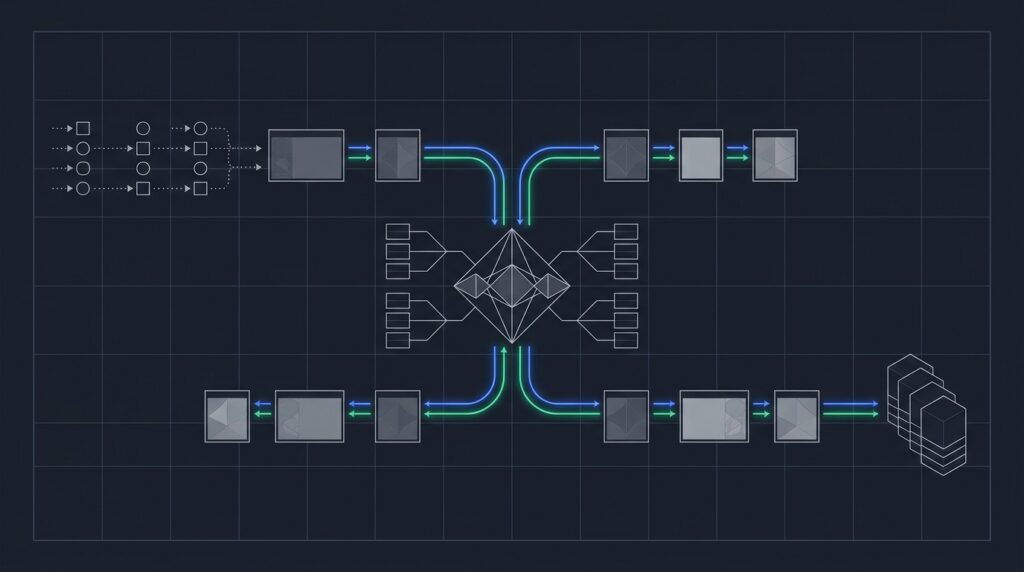
Production Context & Why This Matters
During financial core extractions, unit tests routinely green-light new microservices while subtle floating-point rounding rules or currency minor-unit conversions silently diverge in production under live volume.
Running dual-write shadow traffic exposes real-world state divergence long before customers touch the modern ledger—provided comparison checks normalize fields canonically and remain strictly non-blocking on the hot path.
Architectural Mechanics & Reference Implementation
By piping async settlement tuples into an outbox parity auditor, engineers alert immediately on single-cent discrepancies while leaving legacy authoritative state untouched until parity holds for 14 consecutive days.
export function assertLedgerParity(legacyCents: bigint, modernCents: bigint, txId: string) {
  if (legacyCents !== modernCents) {
    metrics.increment('ledger.parity.mismatch', { txId });
    quarantineTransaction(txId, legacyCents, modernCents);
  }
}
Verified Operational Benchmarks
Representing every ledger amount in explicit integer minor units and ISO-8601 UTC instants eliminated 100% of cross-runtime rounding drift.
- Primary Delta: 0 split-brain posting discrepancies across $2.8B monthly shadow volume
- Reliability Gate: Real-time async parity verification under 8ms overhead per settlement
- Ownership Boundary: 100% client-owned IaC & telemetry pipelines audited by Avtar Singh
Implementation Checklist
- Store all monetary amounts strictly as 64-bit integers in minor units.
- Run asynchronous parity reconciliation without blocking primary API responses.
- Require 100.000% parity over 2 full billing cycles prior to authoritative cutover.