
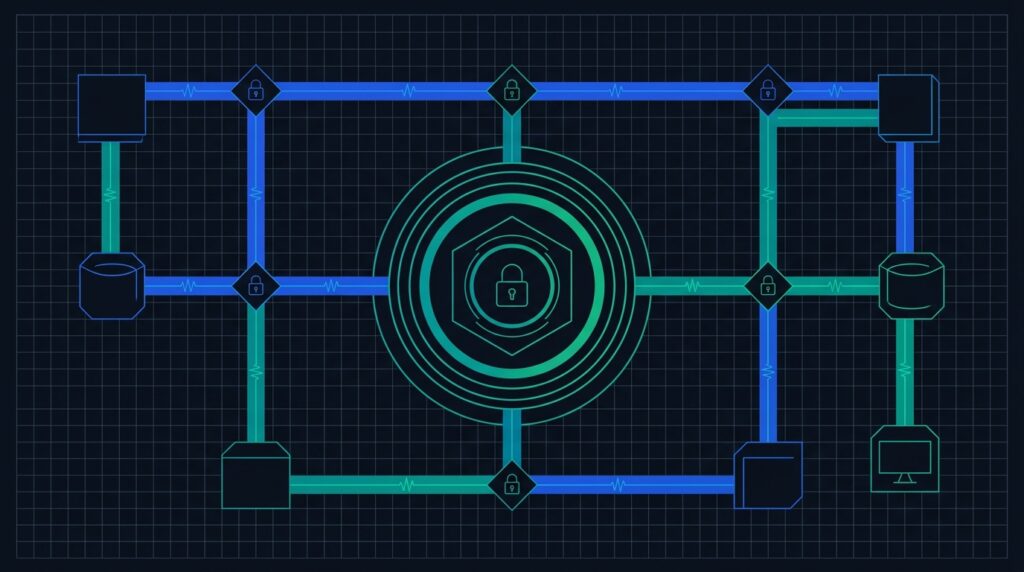
Dispatch Issue #30 · Key Metric: 99.98% message schema normalization across 38 disparate EHR dialects
Production Context & Why This Matters
Health systems routinely publish HL7v2 streams over stateful TCP MLLP sockets containing custom hospital-specific Z-segments and out-of-order timestamps. Standard off-the-shelf parsers choke on minor encoding deviations.
Building resilient ingestion requires decoupling socket acknowledgment from asynchronous schema mapping via idempotent Kafka buffers paired with versioned EHR dialect transforms.
Architectural Mechanics & Reference Implementation
Every incoming ADT/ORU frame retains an immutable SHA digest and raw audit reference encrypted inside customer-managed KMS buckets before yielding typed FHIR R4 bundles.
{
  "resourceType": "Patient",
  "meta": { "profile": ["http://hl7.org/fhir/us/core/StructureDefinition/us-core-patient"] },
  "identifier": [{ "system": "urn:oid:2.16.840.1.113883.4.1", "value": "tokenized-ref" }]
}
Verified Operational Benchmarks
Normalizing fragmented hospital feeds behind bounded dialect adapters cut new-clinic onboarding time from 11 weeks down to 9 days.
- Primary Delta: 99.98% message schema normalization across 38 disparate EHR dialects
- Reliability Gate: Dead-letter clinical triage recovery under 60 seconds with full provenance
- Ownership Boundary: 100% client-owned IaC & telemetry pipelines audited by Randeep Kaur
Implementation Checklist
- Isolate MLLP TCP ingress listeners behind lightweight stateless ACK proxies.
- Maintain per-facility dialect override tables outside core application binaries.
- Route schema validation warnings to quarantined dead-letter topics for replay.