
Dispatch Issue #09 · Key Metric: 0 lost pallet scans across 14,000 daily offline/reconnect transitions
Production Context & Why This Matters
Metal-walled distribution yards and cold-chain loading bays notoriously drop wireless handshakes mid-shift. Request-response REST apps freeze loaders cleanly or overwrite concurrent dock assignments with blind Last-Write-Wins conflicts.
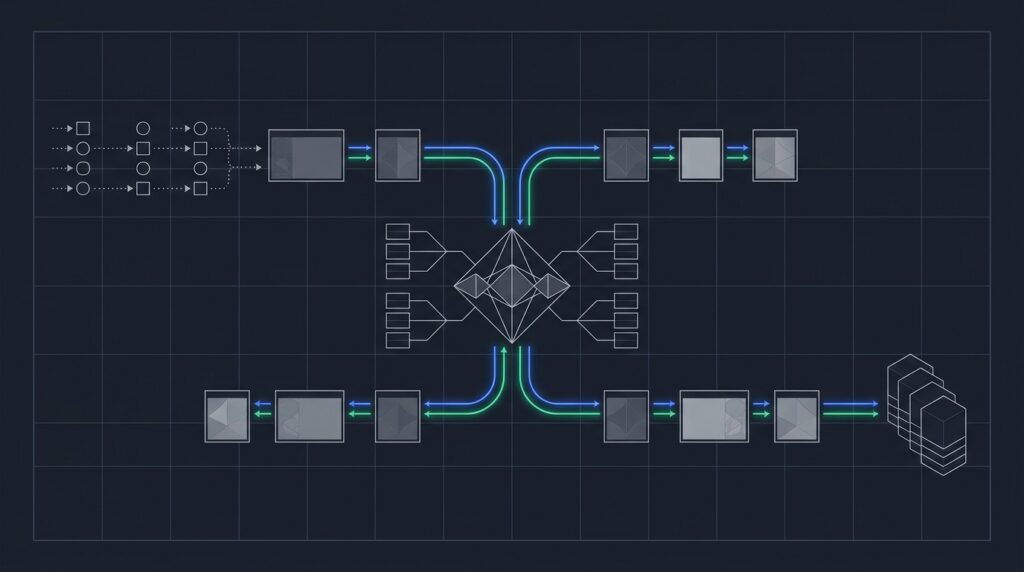
Model-level CRDTs (Observed-Remove Sets paired with Hybrid Logical Clocks) allow ruggedized tablets to commit mutations locally at zero latency and merge state cleanly once connectivity returns.
Architectural Mechanics & Reference Implementation
Deterministic server-side reducers verify causal sequence order so concurrent pallet check-ins resolve reproducibly without operator intervention.
export function mergePalletState(local: CRDTSet, remote: CRDTSet): CRDTSet {
  return {
    adds: unionMaxClock(local.adds, remote.adds),
    tombstones: unionMaxClock(local.tombstones, remote.tombstones)
  };
}
Verified Operational Benchmarks
Adopting local-first CRDT replication eliminated yard terminal stalls and boosted daily trailer turn throughput by 19%.
- Primary Delta: 0 lost pallet scans across 14,000 daily offline/reconnect transitions
- Reliability Gate: Deterministic state convergence inside 1.5s of cellular/Wi-Fi recovery
- Ownership Boundary: 100% client-owned IaC & telemetry pipelines audited by Avtar Singh
Implementation Checklist
- Pair local SQLite/IndexedDB queues with monotonic Hybrid Logical Clocks (HLC).
- Separate commutative inventory adds/moves from exclusive lock workflows like billing.
- Simulate packet loss and 20-minute offline forks continuously in mobile E2E tests.